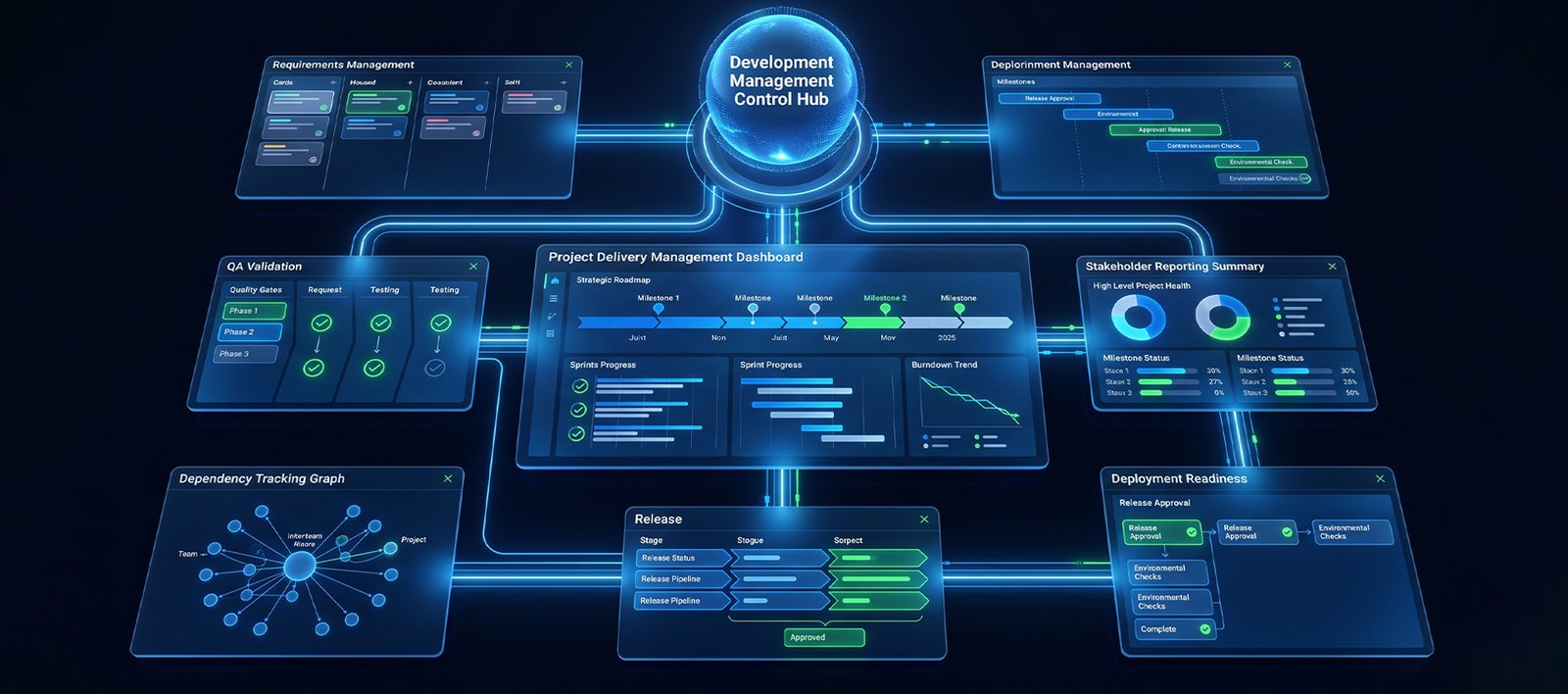
Most projects don’t fail because the team can’t code. They fail because priorities move every week, requirements are unclear, delivery is not governed, and quality is discovered too late. Development Management fixes that. We bring structure to the full build lifecycle—planning, execution, quality gates, release control, and stakeholder alignment—so your product ships on time without chaos.
without chaos.
ZS Global provides Development Management for organizations building digital products, enterprise platforms, and internal systems. Whether you’re launching an MVP, rebuilding legacy modules, or scaling a multi-team roadmap, we help you run development like a discipline: clear scope, measurable progress, controlled change, and reliable releases.
Development can look active while outcomes stay stuck. Our role is to convert activity into delivery. We build a management layer that clarifies what must be built, what can be deferred, what is risky, and what is ready to ship—then we enforce that discipline across the team.
We translate business intent into build-ready requirements, define acceptance criteria, and lock priorities for each sprint or release. This prevents scope creep from quietly destroying timelines.
We create realistic release plans based on capacity, dependencies, and risk. Stakeholders get a transparent roadmap, not optimistic dates.
We introduce quality checkpoints (definition of done, test coverage expectations, staging validation) so issues are caught early—not in production.
If your roadmap depends on multiple teams or vendors, we build dependency maps and coordination routines that stop blockers from hiding.
We align environments, CI/CD flow, branching strategy, and deployment processes so releases are repeatable and safe.
Weekly reporting is not enough if it’s vague. We provide clear metrics: burn-up/burn-down, milestone status, defect trends, and risk logs—so leadership sees reality early.
We identify the top delivery risks (unclear requirements, integration points, performance constraints, data quality, security gaps) and actively mitigate them with concrete actions.
We implement conversion tracking and dashboards so you can see what drives revenue across channels, products, and customer segments and make decisions based on real data.
We start by reviewing your current state: backlog quality, architecture constraints, team capacity, existing timelines, environments, and delivery pain points. We identify what is blocking predictable execution.
We set the working cadence and governance: sprint rhythm, planning rituals, backlog grooming, review practices, and escalation paths. This defines how work moves from idea to shipped release.
We structure your roadmap into milestones with clear goals, dependencies, and measurable outcomes. We then define a realistic plan based on capacity and risk rather than assumptions.
We convert priorities into build-ready stories with acceptance criteria and edge cases. This reduces rework, improves estimation, and increases testability.
We run standups, manage blockers, enforce WIP limits when needed, and keep teams focused on the sprint goal. We track progress daily—not at the end.
We align QA strategy, staging validation, UAT coordination, and regression practices. Releases ship only when the defined gates are met.
When priorities change, we manage the trade-offs. Stakeholders get clear impact analysis on scope, timeline, and cost before any change is accepted.
After each release, we run retrospectives focused on measurable improvements: cycle time, defect rate, handoff delays, and incident patterns.

Development Management focuses specifically on running the software build lifecycle—requirements clarity, engineering execution, quality gates, release control, and dependency management. Project Management can be broader; Development Management is the hands-on operating system for shipping software.
We work with Agile, hybrid, and milestone-based models. The delivery rituals change, but the core discipline stays: scope control, measurable progress, quality gates, and release readiness.
Yes. We can complement your existing leadership by strengthening planning, execution tracking, reporting, and cross-team coordination—or we can temporarily fill gaps where delivery ownership is missing.
We lock sprint or milestone scope using clear acceptance criteria and change control. If new work is added, we show the impact on timeline, cost, and delivery commitments so stakeholders can make informed trade-off decisions.
We work with your existing stack—including Jira, Azure DevOps, Asana, Trello, ClickUp, GitHub, GitLab Boards, and similar platforms—then standardize workflows, issue states, dashboards, and reporting within those tools.
Yes. We coordinate quality assurance activities, testing strategy, staging validation, regression testing, user acceptance testing (UAT), and release readiness to ensure software meets defined quality standards before deployment.
We track sprint velocity, burn-down and burn-up charts, milestone completion, defect trends, release readiness, delivery risks, cycle time, and other KPIs to provide transparent visibility into project health.
Yes. We coordinate communication, dependencies, responsibilities, and delivery schedules across internal teams, external vendors, and outsourcing partners to keep projects aligned and moving forward.
That is common. We help refine business needs into structured requirements, prioritize the backlog, define acceptance criteria, and implement controlled change management so evolving requirements do not derail delivery.
Simply schedule a consultation with our team. We will assess your current development process, identify delivery bottlenecks, and recommend a structured management approach with a clear implementation roadmap.
ZS Global helps you manage development with disciplined execution, clear reporting, and release confidence. If you want faster delivery without quality trade-offs, we’ll build the management system that makes it repeatable.

ZS Global is an independently owned and operated business. It has no affiliation, association, partnership, sponsorship, endorsement, ownership, control, or other direct or indirect relationship whatsoever with ZS Associates, Inc. or any of its affiliated entities.